Wednesday, March 20, 2013

1920's In-Class Assignment

1.  Unlike the majority of U.S. residents at the time, President Harding believed that World War I was not necessarily at fault for the increased moral degradation of the American people.  He was convinced that, instead, the disregard of American law on behalf of highly influential, authoratative figures within the nation paved the way for other members of society to follow, subsequently leading to horrific ethical corruption.  If respect for the law was to be maintained, such figures of influence had to have led by example.

2.
The Drunkard's Progress


     With a lack of temperance, upper-class members of American society often fell victim to alcoholism, leading them to engage in disorderly conduct.  Excessive spending on alcoholic beverages in an attenpt to satisfy their addiction  impoverished a number of them.  The drinking also diseased them, attacking, and gradually weakening, their livers.  They soon found themselves alone, unwanted, friendless, and in utter despair.  With little to their name and virtually no hope for bettering their condition, they resorted to a life a crime.  Seeing no purpose in living such a life of distaste any longer, many committed suicide.

Till Death Do Us Part
In the latter portion of the 19th century and into the early 20th century, alcoholism was the number cause of marital divorce in the U.S.  It plagued matrimonies with extreme domestic violence and uneccesary spending, shattering homes and ,in turn, the lives of children across the nation.

Monday, March 11, 2013

WWI (Part 1)

How the following factors lead to war:

1) Imperialism:  as a result of it, intense rivalries among various nations arose across the globe.

2) Militarism:  military expansion simply made war inevitable, for, it sparked tension among numerous countries on a national scale.

3) Nationalism:  nationalistic nations often acted on behalf of their own interest, completely ignoring that of neighboring nations and harming them as a result.  This only served to heighten resentment and the potential for combat among the nations.

4) Alliances:  once a nation began to have issues with another, a domino effect was initiated; the nations' allies were dragged into the conflict, blowing it out of proportion and igniting a war.

American Imperialism


     The political cartoon above illustrates the incredible extent of American imperialism by the end of the 19th century.  It also conveys the astute pride the U.S. had in having dominion over such a wide array of global nations, depicting iconic, nationalistic symbols, such as the eagle, colonial stripes, and state stars, about the globe.

Factors contributing to the U.S. decision of becoming an imperialistic nation in the latter portion of the 19th century include:  nationalism (as expressed above), militarism (Naval base and troop expansion), humanitarianism (westernization), and economic opportunity (natural resources and new markets for manufacured goods).

Industrialization, Urbanization, Immigration, & Flagler


Industrialization at its finest:  the very first oversea train locomotive reaching its desitnation at Key West off the Florida peninsula.


Ahh, a product of the Gilded Age, Hotel Ponce de Leon, one of the most luxorious establishments ever to come into existence.


Immigrant railway labor:  the best one can acquire; low wages, high profits, content workers. 

The Rise of Labor Unions


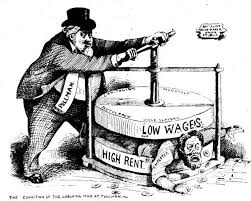
     As industry reached new heights in the 19th century, relations between factory owners and their respective employees began to suffer, shifting from that of a personal nature to that of sole busniess interest.  The result:  intense exploitation of factory workers; they were paid meager wages and arduously labored for seemingly endless hours in conditions which weren't the least bit pleasurable.  Soon enough, however, the laborers began to feel a desperate need for change; yet, the fact that minute resistance was not going to suffice in bringing about such change thwarted the desire in many.  Individual workers could easily be replaced by those willing to take on the exploitative jobs; immigrants, for instance.  In light of this, countless workers who could bear the harsh nature of their self-absorbed employers no longer decided to come together in the latter portion of the 19th century to better their conditions, forming so-called "labor unions" in the process.  The Federation of Organized Trades and Labor Unions, founded in 1881, is just one of the several unions formed at the time.  It was succeeded by the American Federation of Labor in 1886, whose sole task involved the use of srikes, boycotts, and negotiations to win better working conditions, higher wages, and union recognition under the dominating capitalist system of the time.  Unions such as this gained increasing infulence through time and, ultimately, helped promote the passing of labor laws and regulations for the benefit of the poorly kept, working-class citizens who comprised them.

     The picture illustrated above conveys the sheer cruelty and inconsideration late 19th-century factory owners had toward their virtually helpless employees.  The words, "monopoly, capitalism, plutocracy, and wage slavery," sit at the top of the upper gear.  These very words provide insight into what allowed such atrocities to take place at the time; the enterprise owners abused the capitalist economic system of the time to form business monopolies, which granted them an unimaginable amount of weallth and, in turn, power (plutocracy).  Afterward, the egoists exploited their workers (essential slaves), paying them as little as possible, while, at the same time, charging them a preposterous rent fee.  This led to the inevitable formation of the many determined and solidary labor unions which helped change the way things were managed in the work force forevermore, setting the foundation for what it is today.

Thursday, March 7, 2013

Manifest Destiny

File:American progress.JPG

     The American settlers and railways depicted in this painting are moving in a westbound direction and are being guided by a centrally-located, eye-catching angel, illustrating the sole desire the U.S. had during the initial stages of the Manifest Destiny era: expansion to the west of the Mississippi River in  pursuit of Christianizing heathen Native Americans and, thus, fulfilling its "destiny."  The Natives and their respective animals express a sense of utter terror and confusion toward the essential invasion taking place in their homeland, erratically fleeing the scene into what seems to be a cloud of destruction. The settlers, as well as the angel, are gradually establishing themselves in the area, constructing bridges, electrical lines, and the like, as they move further west.